Longtime philanthropists Brenda and Greig Nicholls
support brain research in big ways
By Olivia Piché • Photography by Jared Sych
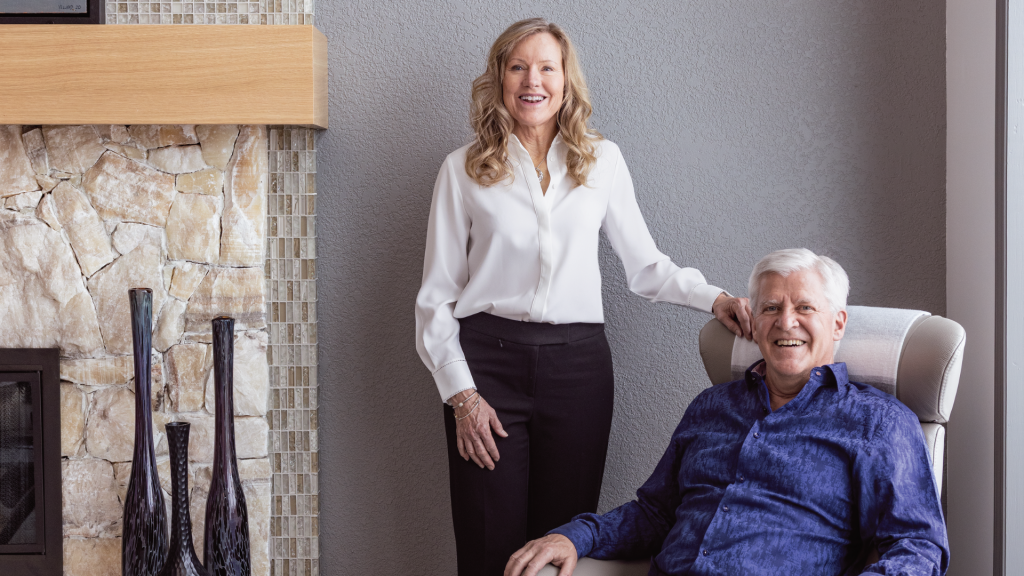
Sometimes, it takes a life-altering moment to remind you of what’s important. That was the case for Brenda and Greig Nicholls. In 2000, Brenda experienced a brain bleed from a ruptured aneurysm. It was located in a surgically challenging part of the brain, meaning a highrisk surgery was necessary.
Brenda came under the care of renowned neurosurgeon Dr. Garnette Sutherland, who performed the surgery successfully. “If I had not had Dr. Sutherland as my doctor, I’m not sure if I would be here,” she says.
“It redefines your life when you go through an experience like that. It takes you off on a different path, and you change your priorities,” says Greig. “That was really the start of leaning more towards charity.”
The beginning of a giving journey
Once recovered, Brenda adjusted her will to include a donation to brain research. The couple then established the Nicholls Family Fund through the Calgary Foundation in 2004. Brenda and Greig wanted to support local charities focused on children’s education and well-being. Having grown up in Calgary, the Nicholls wanted to support kids and give them opportunities to reach for their dreams and find success as they had been able to.
“Living in Calgary made it possible to feel like we had the ability to give back to our city,” says Brenda. “We felt like we had enough to share, and so we thought, ‘Let’s make a plan on how we want to do that and follow through with it.’”
And so they did, providing major gifts to the Calgary Public Library, Wilder Institute/Calgary Zoo and TELUS Spark Science Centre, as well as programs like Brown Bagging for Calgary’s Kids and Calgary Apraxia.
A pivot in philanthropic interest
While the Nicholls have had decades of impact supporting young Calgarians, their major philanthropic efforts recently shifted because of a second life-changing moment. In 2024, Brenda had another brain aneurysm, despite the slim possibility of recurrence.
Although Dr. Sutherland did not perform Brenda’s recent brain surgery, he ensured her treatment was safely executed by consulting with his colleagues. Brenda once again recovered well, and this time around, she didn’t want to wait to make a difference.
After touring Dr. Sutherland’s research facility with his robotic system, Project neuroArm, the Nicholls decided to significantly contribute towards his work. That includes supporting research and innovation projects for improved and safer brain surgery, such as a digital platform for interconnected collaboration between international surgeons.
“Whatever they can do to make surgeries safer going forward is definitely welcome,” Brenda says.
Impact, near and far
The Nicholls understand this research will not only improve the future for Calgarians but also for all those who suffer from neurological diseases around the world. Still, the duo is proud to be part of the philanthropic fabric of Calgary, a city with a can-do attitude and a drive for world-leading institutions, as Greig explains. He adds that anyone can start their philanthropic journey.
“The Calgary Foundation is fabulous at providing information on charitable needs in our city, making it easy to enter the world of philanthropy,” he says. Brenda adds, “We grew up here, and we have been successful here. Thus, it feels like this is where we should be giving back to show appreciation for what we have experienced and the opportunities Calgary provided us.”
June 2026